Thread by Arthur Turrell
- Tweet
- Dec 10, 2022
- #Nuclearpower #EnergyPolicy

Thread
Nuclear fusion is much closer than you think!
A short 🧵👇🏾
(You can find pretty much everything in this thread in #thestarbuilders book: #writing' target='_blank'>aeturrell.com/)
A short 🧵👇🏾
(You can find pretty much everything in this thread in #thestarbuilders book: #writing' target='_blank'>aeturrell.com/)
First, what is nuclear fusion? It's a reaction that literally creates new atoms from old: lighter nuclei (say types of hydrogen) are smashed together to make heavier nuclei—and LOTS of energy. And the energy comes from an equation you already know! (Yes the one by Einstein) 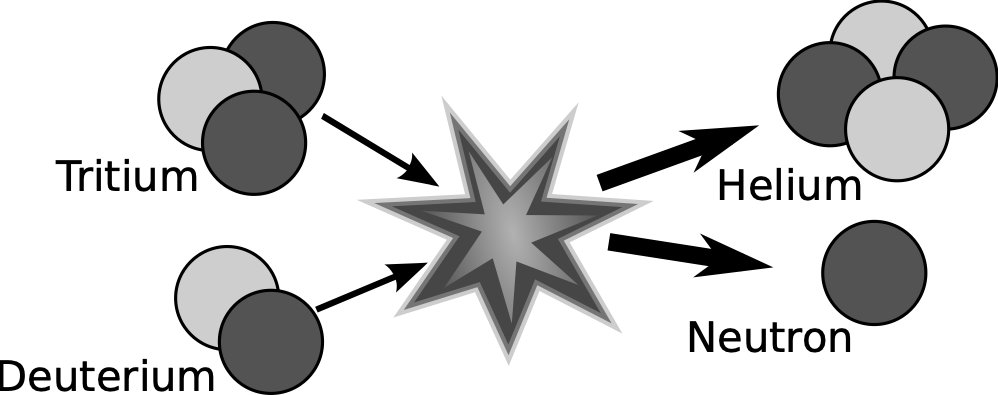

You should care about fusion: apart from being the reaction that makes the Universe light up (powering stars) and the reaction that created most of the elements we're made of, fusion promises clean, safe, low radioactivity energy for everyone—and wow do we need more clean energy 

When I say everyone, I don't just mean *today*—it's for the future too. Fusion's special hydrogen ingredients are outrageously common on Earth: 5g in every bathtub of seawater is deuterium and tritium can be made from lithium; there's likely enough for millions of years of energy 

Now, there is a catch to this carbon-free energy source: fusion is hard! It happens at start of the universe, in stars, & in supernovae, but those are extreme places. We need to recreate those extreme conditions on Earth if we want to get energy out from fusion reactions. 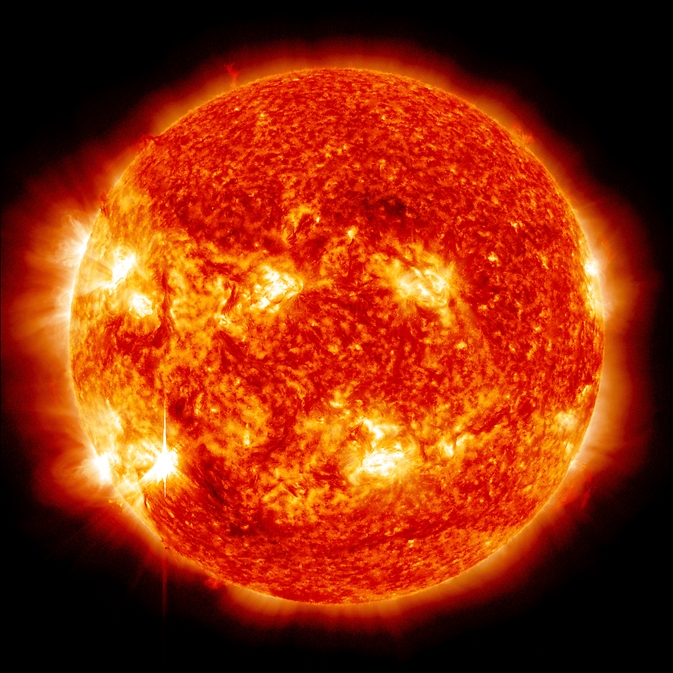

Scientists, engineers, dictators, and even porn magnates have been trying to do fusion since the 1940s. The problem is that creating the extreme conditions needed—temperatures in the millions of degrees and pressures 300 billion times Earth's—requires a lot of energy up front.
The trick is to get NET energy gain: more energy out than you put in. This is the big prize in fusion. Demonstrating this a single time, in a single experiment (ignoring the energy cost of running the lab) would be a huge landmark in attempts to get clean energy from star power
Now the joke is that fusion is "30 years away... and always will be!". But actually HUGE progress has been made in fusion over the decades, and the last few years have really seen things, err, heating up.
Here's a GIF I made showing the progress 👇🏾
Here's a GIF I made showing the progress 👇🏾
Right, big recent breakthroughs: in February, the JET experiment released the highest total amount of energy from fusion reactions ever (59 megajoules); in just 5 seconds there was enough energy released to boil about 60 kettles. Close to industrial scale!
www.bbc.co.uk/news/science-environment-60312633
www.bbc.co.uk/news/science-environment-60312633
This wasn't net energy gain: they got 33% of net energy gain for five seconds, and the record on that machine is 67%. But it was a LOT of (gross) fusion energy, & controlling fusion for five seconds at 100 million degrees, almost ten times hotter than the Sun, is super impressive
Last December, China’s EAST "tokamak" machine managed to control fusion conditions, 100 million degrees, for 1000 seconds. This is a stunning development given control used to last for <milliseconds. Though the machine is not running with 'real' fusion fuel (unlike at JET)
Other exciting news: proof that a 'stellarator' fusion machine could work, *billions* of USD in investment in the fusion industry, and new superconducting magnets (better control) that produce magnetic fields half a million times stronger than the Earth’s.
But what I'm MOST excited about is progress on the US' National Ignition Facility, @lasers_llnl. In August last year, they hit 70% of net energy gain! A world record.
Lots of people got interested in NIF, including @coreyspowell and @emollick
Lots of people got interested in NIF, including @coreyspowell and @emollick
As I said at the time, this is so close to breakeven (100% energy out for energy in) that surely, surely NIF will get there first...
How they could get there might involve cracking some insanely hard physics and engineering, or just hitting it with a bigger laser—or, as NIF's Operations Manager Bruno called it, "a bigger hammer". An excerpt from #TheStarBuilders book: 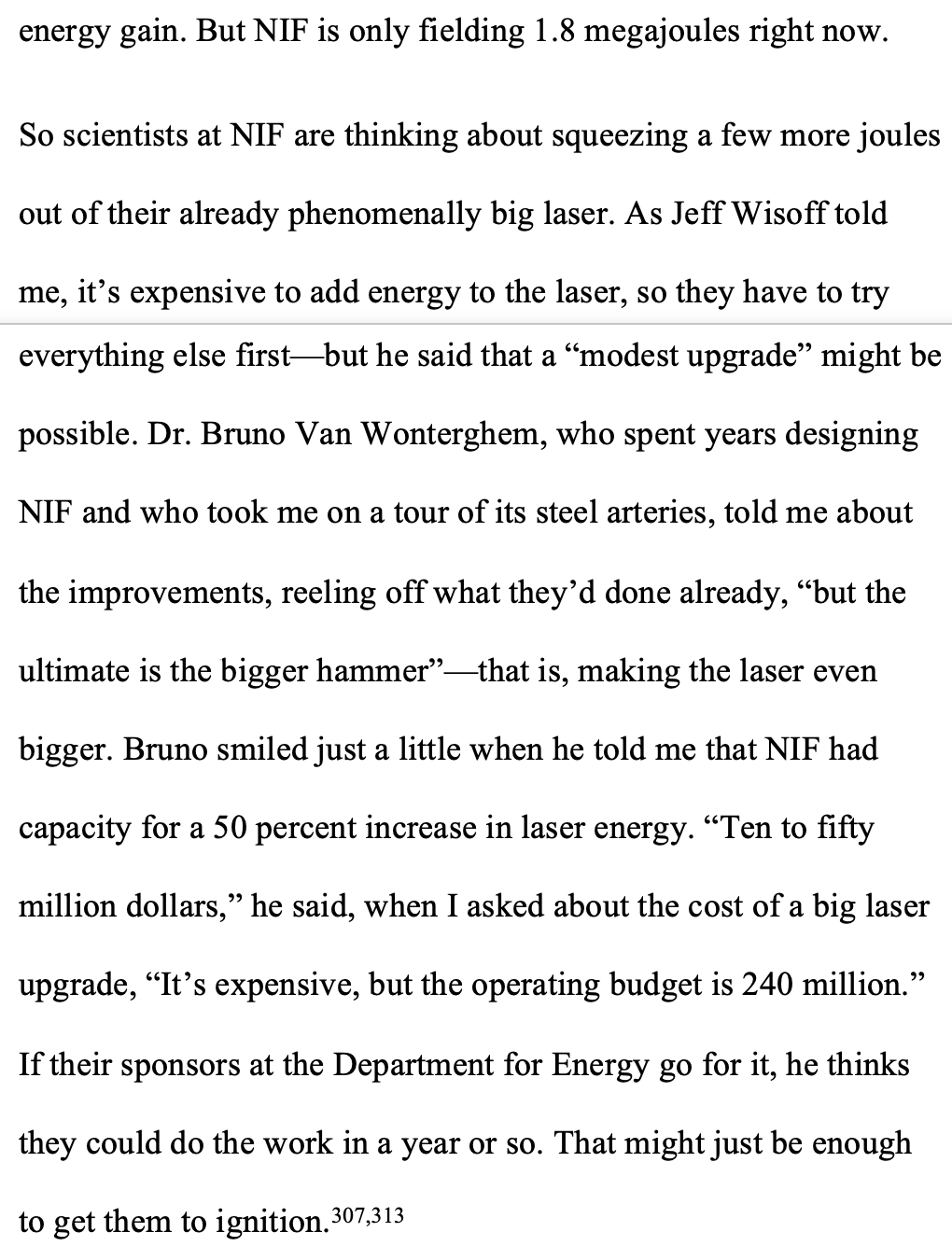

And guess what? NIF has been ramping up the laser energy... take a look at this from a recent blog post from November on a laser shot where staff upped the input energy (the hammer) from 1.8 megajoules a couple of years ago to more than 2 megajoules in September: 

By the way, if you're not sure how NIF works—it uses a laser to squeeze enough energy into a small time and space that fusion conditions are created. And it does it only for a brief time before the capsule it fires at falls apart. In those TEN NANOSECONDS though, fusion happens 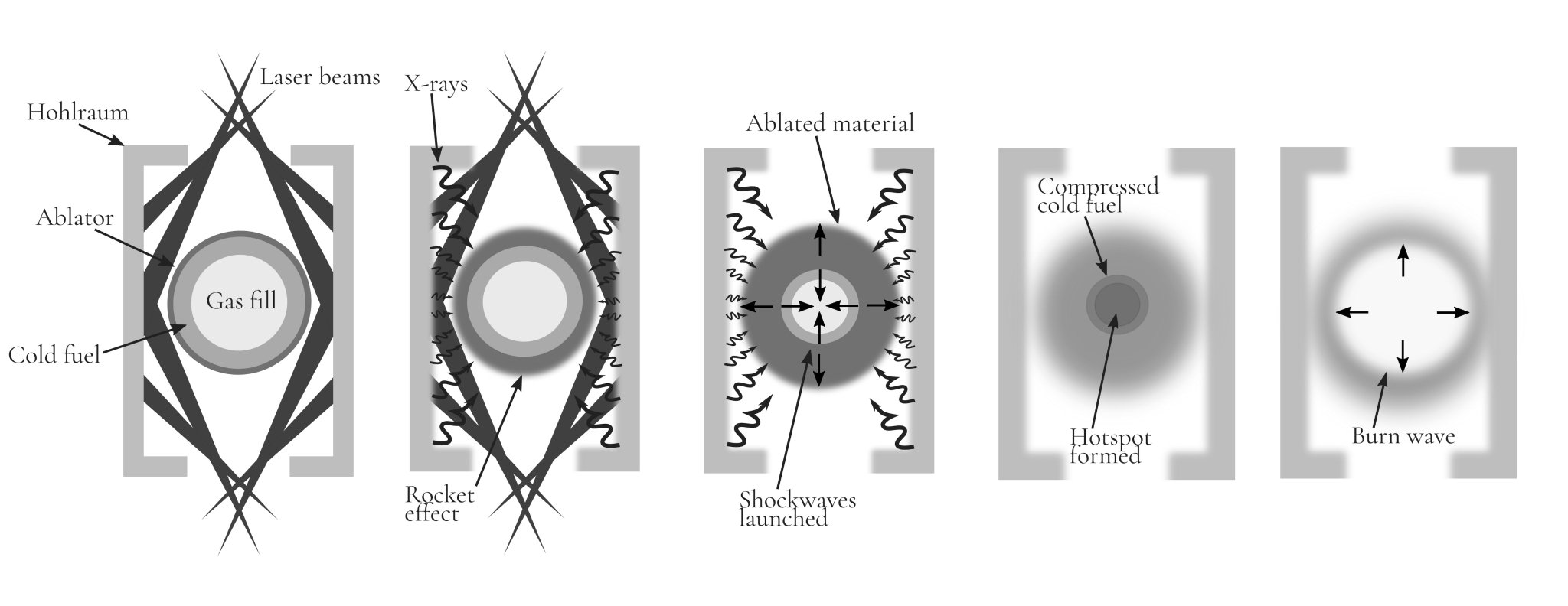

That's it for now for this #nuclearfusion thread. You can find more on the high laser energy-input experiments from NIF here: lasers.llnl.gov/news/high-energy-shot-puts-nif-back-on-track-toward-ignition
For now, I'll leave you with this excerpt from #TheStarBuilders 🌟
For now, I'll leave you with this excerpt from #TheStarBuilders 🌟

I am terrible at tagging people who might potentially be into the content in threads but yeah @Noahpinion, @AdamRutherford, @mattsclancy, @AstroKatie, @FryRsquared you all have followers who might find this thread on fusion being closer than you think interesting.
And here's an EXTREMELY exciting update on this thread... we could actually have hit scientific net energy gain
Mentions
See All
Matthew Yglesias @mattyglesias
·
Dec 10, 2022
Really interesting thread here