Thread by Christos Constantinidis
- Tweet
- Sep 19, 2022
- #Neuroscience

Thread
New preprint from the lab!
Prefrontal neuronal dynamics in the absence of task execution (1/10)
www.biorxiv.org/content/10.1101/2022.09.16.508324v1
Prefrontal neuronal dynamics in the absence of task execution (1/10)
www.biorxiv.org/content/10.1101/2022.09.16.508324v1
In recent years, there has been a major shift in the analysis of neural activity from the level of single-neuron responses to those of populations, often referred to as the “population doctrine”. For an eloquent review, see Ebitz and Hayden, 2021
www.sciencedirect.com/science/article/pii/S0896627321005213
(2/10)
www.sciencedirect.com/science/article/pii/S0896627321005213
(2/10)
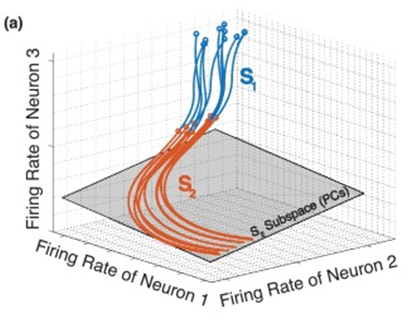
For non-sensory brain areas, most of the variance of neural activity can be captured by a few dimensions, using PCA or other dimensionality reduction methods to represent the joint activity of neurons in a population (fig. from Suxena and Cunningham, 2019) (3/10) 
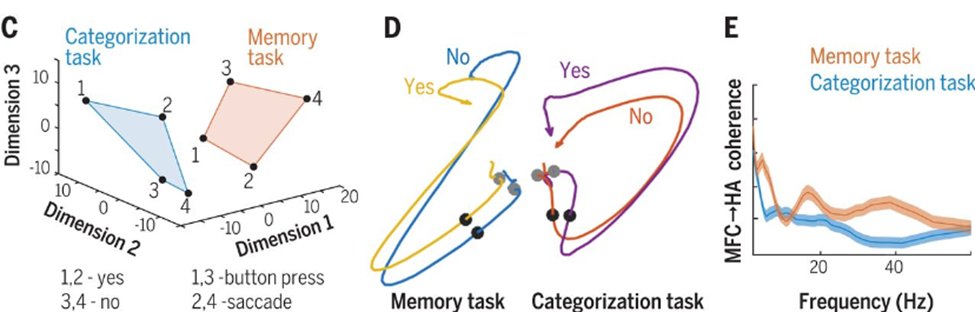
Furthermore, these representations undergo systematic transformations during the executions of cognitive tasks, for example different rotations for different tasks (fig. from Minxha et al., 2020) (4/10) 
Most recently, these analyses have found application in working memory and prefrontal cortex. Orthogonalization of a stimulus representation during the delay period of the task has been proposed as a method of reducing interference or achieving optimal information loading (5/10)
We explored this idea in a dataset of prefrontal recordings, in subjects trained to perform spatial and shape working memory tasks. We indeed confirmed that a) a low dimensional representation captures most of the variance of prefrontal populations in this task (6/10)
b) Substantial transformations are present between the task periods involving presentation of the original stimulus the subject has to remember and the subsequent stimulus the subject has to compare it with (7/10)
Things took an unexpected turn, however, when we analyzed recordings available from the same subjects, before they were ever trained to perform the task, when they viewed the same stimulus sets passively (8/10)
We found substantial stimulus transformations prior to training, which essentially remained the same after training, and were specific for each subdivision of the prefrontal cortex we examined (9/10) 
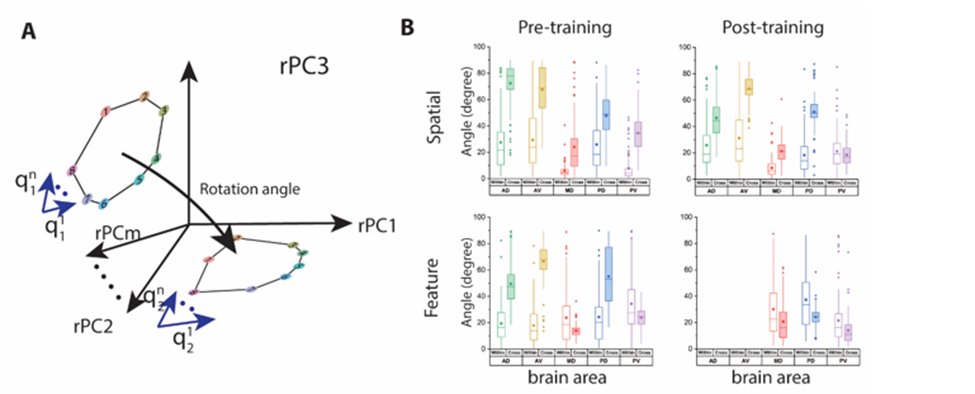
We did find some geometry transformations that were specific after training to execute the task – as well as differences between correct and error trials, which confirm that behavior has access to such transformations (10/10)
Our critical finding however is that prefrontal circuits automatically perform rotations of stimulus geometry, absent any task execution, even in subjects naïve to task training (11/10)
Many thanks to the people who did this work and particularly Shusen Pu, my former postdoc, now an Assistant Professor of Mathematics in UWF, and Wenhao Dang, a Research Assistant Professor in my group at Vanderbilt. Suggestions, comments, and ideas are very welcome! (12/10)
