
Thread
I regularly scoff about the wild claims about the yuan replacing the dollar as a global currency.
But every time I look at the data I'm still *amazed* at just how irrelevant the yuan is:
www.bloomberg.com/opinion/articles/2022-03-16/saudi-arabia-s-oil-for-yuan-proposal-won-t-threaten-the...
But every time I look at the data I'm still *amazed* at just how irrelevant the yuan is:
www.bloomberg.com/opinion/articles/2022-03-16/saudi-arabia-s-oil-for-yuan-proposal-won-t-threaten-the...
Banks *in China itself* still use the greenback for more than two-thirds of their cross-border claims. Just 14% are denominated in yuan. 

As is often pointed out, the Swiss Franc and Canadian and Australian dollars are used in more FX transactions than the Chinese yuan.
It's likely the yuan is more used down than in this 2019 data, but also consider that much of those flows will be with the Hong Kong dollar.
It's likely the yuan is more used down than in this 2019 data, but also consider that much of those flows will be with the Hong Kong dollar.

Which however you look at it is not exactly a global monetary transaction.
The key thing that I think people fail to understand about the dollar's global importance is that it's founded not so much on the U.S. dollar regulated by the U.S. Federal Reserve, but the eurodollar, an instrument that few people know about and fewer understand.
Are eurodollars money? Well, kinda. They owe their value to the fact that they're freely convertible with U.S. dollars, on the balance sheets of banks in the U.S. But they are created on the balance sheets of banks outside the U.S. and not subject to Federal Reserve regulation.
But I don't feel people are that much more clear about the role and significance of eurodollars than they were in 1971, when Milton Friedman wrote this highly readable paper on the nascent market:
files.stlouisfed.org/files/htdocs/publications/review/71/07/Principles_Jul1971.pdf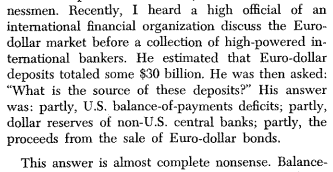
files.stlouisfed.org/files/htdocs/publications/review/71/07/Principles_Jul1971.pdf

Eurodollars were the crypto of their day -- a way to create money out of sight of government regulation. Their origin was in the dollar deposits of Communist countries after World War II, which the kept in Europe so that the Fed wouldn't be able to freeze their assets.
It's absolutely true that the Fed's post-2008 swap lines, and the growing use the dollar to extend the reach of Washington's secondary sanctions, and the action against the central bank of Russia last month, start eroding the eurodollar's autonomy.
But compare it to assets in a country like China with a closed capital account and sweeping asset forfeiture rules like China's so-called anti-sanctions law last year, and money based on the eurodollar is still the closest thing the world has to unregulated global finance.
If China opens up its capital account, starts running up huge budget deficits to provide more of a supply of safe assets, and establishes a solid reputation for rule of law, it might start to chip away at the edges of this edifice.
But any one of those conditions on its own would be an epic, extraordinary policy change, and would take decades to come to fruition. And that only gets you to the point where the yuan is as important as, say, the euro or the yen.
Dollar dominance is going to be with us for decades to come. (ends)
Mentions
See All
Ben Hunt @EpsilonTheory
·
Mar 18, 2022
Fact check: TRUE (excellent thread)